
| mcol.xyz / posts / Qtile: A Wayland Compositor | code |
| about |
What is this? Qtile? A Wayland compositor? Wut? You're reading right my dudes,
now it is one. Since way before I joined the core Qtile dev team over a year
ago there has been a vague drift in the codebase moving the X11-specific code
into a backend module with the aim of abstracting away the interface
the WM makes with the X server. The idea was that other backends could be
implemented and use the same higher-level management of windows, screens,
groups (virtual desktops), the status bar, etc. Over the past few months I've
been working on the first non-X11 backend: a Wayland compositor.
This backend -- which was part of the latest release a few weeks ago (0.18.0) -- uses the Python CFFI wrapper around wlroots created by flacjacket, pywlroots. This in turn uses pywayland also written by Sean. Through pywlroots, Qtile gets access to the amazing work put in by the wlroots guys to make constructing a compositor straight forward and hassle-free.
With the latest releases of the three projects above, launching Qtile as a Wayland compositor is as simple as running the following from a TTY:
qtile start --backend wayland
With it fired up, the first thing to notice is.... nothing!

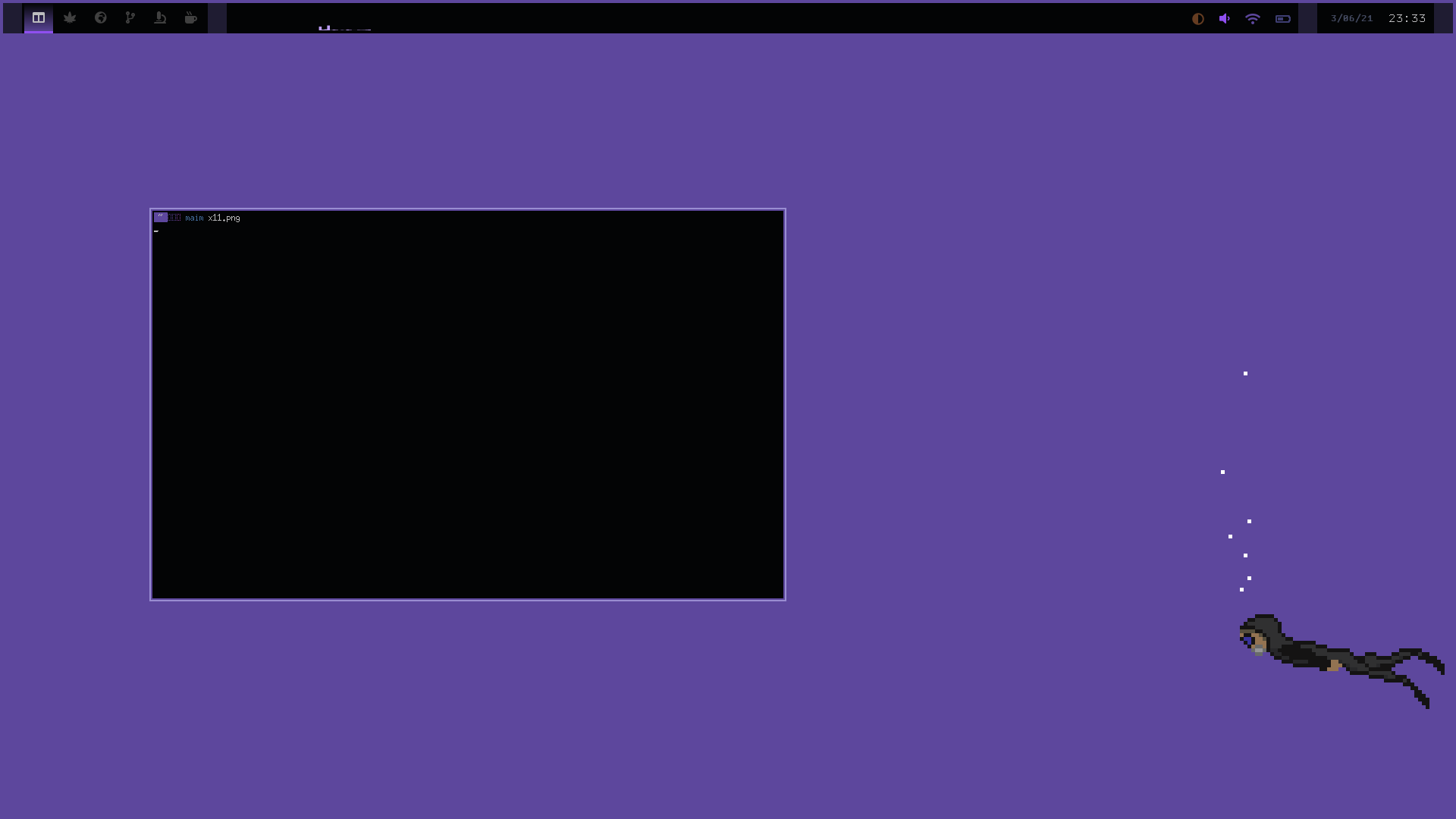
So what are we looking at here? These two screenshots are my desktop running using the Wayland backend (top) and the X11 backend (bottom). Ignoring the difference in terminal (foot and xterm), everything else is the same. The same bar (Qtile's own bar), the same window borders, and (you'll have to take my word for it), the same keybinding and mouse behaviour.
But why? Other than the totally valid reason of "it's awesome", I was getting sick of the visual glitches and imperfection that inevitably come with X, and this backend gives us pixel-perfect rendering [1]. And testing them out one after the other it is certainly noticable. We also get nice things like easier to control clients (on the dev side and user side), fewer buggy or slightly misunderstood interfaces, but I don't need to supplement the many articles online about why Wayland is A Good Thing.
Writing the backend was a great opportunity to refactor some of the code and really isolate and modularise the X11-specific parts as these are not used when ran for Wayland. It also helped shape the base classes required to create further backends. Based on their signatures, one can implement custom backends to handle whatever input-output setup one wants, be it a web-based compositor like Greenfield or a VR desktop environment à la Safespaces.
The first thing some people will notice when running a Wayland Qtile for the first time is that suddenly half of their programs no longer work. Many popular programs run on X only and alternatives need to be found. This can be as simple as replacing dmenu with bemenu. Some fine people have collected links to alternatives for popular programs, so if this is what you want then check out Are We Wayland Yet? and natpen on GitHub's Awesome Wayland page.
Some programs, such as Firefox or GTK and Qt-based programs, require environmental variables to be set for them to use their Wayland backend. For more info check out this page on the Sway wiki.
Many other compositors, such as Sway, support compatibility with X-only windows via the XWayland tool. This essentially serves as an X server that lets the compositor handle the pixel buffers of all the X clients so it can embed them within the Wayland desktop environment as regular windows. People who might want to use this in Qtile are unfortunately out of luck, as XWayland support is not implemented, and I am in favour of deferring its implementation indefinitely as it would introduce much more complexity to the code for what is ultimately a temporary workaround.
The X server reads config files from /etc/X11/xorg.conf.d to use when
configuring input devices managed via libinput. With many things, this becomes
the responsibility of the Wayland compositor. Currently there is no common
interface or configuration that can be shared between compositors, meaning each
compositor has to manually deal with libinput configuration itself. I have
implemented this in this pull
request, but I agree with the consensus that this feels wrong to have within
Qtile. Sway does something similar; configuring libinput devices itself (with
identical config options to X or that Qtile PR).
It's a bad situation, but currently using the commit from that PR [2] is the only alternative to getting used to your input devices' default settings. My fingers and toes are crossed that a plug-and-play implementation comes onto the Wayland scene with a config that all compositors could use.
In Wayland Qtile is the compositor so there can be no standalone compositing manager like under X. If you use picom then you need not worry about screen tearing at all, and transparency works native and out-of-the-box. Window drop shadows, however, are something that would need manual implementation within Qtile. In part I am hoping that somebody comes along and decides to hack away at a plugin for Qtile that will do this, because I do think drop shadows are out of the scope of Qtile proper. Alternatively if the wlroots people decide it's worth making this a trivial job for compositors then that would be even better. Either way, shadows are currently not possible.
The crusty old Systray interface from X11 uses a very X-specific window embedding protocol and as a result can't be supported outside of X (and even with XWayland, it would only provide a systray interface for the X clients).
Instead, the desktop-agnostic Status Notifier Item dbus interface provides a protocol through which clients can specify icons and context menus for sticking in a system tray. This has roots in KDE's move to Wayland and has been adopted by many other Wayland servers as well as many client applications. Currently elParaguayo is working on a widget that will provide this systray implementation, though this is a work in progress.
There are still some TODOs that need working on to make everybody happy:
- Drag-and-drop
- The configure-ack-configure dance with clients to get atomic layout changes and window resizes
- Proper DPI and output scaling support
- Lock-screen management - ongoing discussion within wlroots is still deciding on how this should work in Wayland
| [1] | To be precise, it provides the potential for pixel-perfect rendering. This requires a back-and-forth sync between the server and clients when geometry is going to change, but this is not yet fully implemented in Qtile so when you resize a bunch of windows at the same time (e.g. moving a split in a tiled layout) they all move at the same time, but don't resize at the same time. |
| [2] | Really I should extract the logic from that PR and put it into a standalone Python file that people can import into their configs and use that way. At least, until a better solution appears. |
If you have any thoughts, comments, criticisms, feel free to reach out on mastodon or by email ʕ•ᴥ•ʔ